Watched a programme on the palm oil industry last night. Can't really believe how short-sighted some corporations are. A smiling executive from Sinar Mas calmly explained how the rainforests in Indonesia are 'unproductive' and they were cleverly and systematically cultivating them with palm oil plantations instead. It wasn't the job of Sinar Mas, he stated, to worry about CO2 emissions causing global warming, they were providing a valuable resource for the people of Indonesia. Millions of hectares of prime rainforest are being slashed and burnt every year.
Cut to the indigenous people in these areas who are now forced to trek miles to beg permission from nearby farmers to dig for roots. These same local people are supposed to own the forests, but are powerless to stop the loggers coming in and raping their land. Unsurprisingly the police are paid better by Sinar Mas than they are by the state and little serious action is taken to protect their rights. Apparently all Sinar Mas have to do to receive permission for new plantations is prove that an area of rainforest is not productive (which in this case means not cultivated). The production of oxygen, fixing of CO2, provision of natural habitats for wildlife and protection of biodiversity are seemingly not covered under this description.
And palm oil? Alarmingly common in many of the products we put in our shopping baskets every week, it's often listed as vegetable oil. It's cheap and versatile and yet costs the earth!
http://www.greenpeace.org/usa/news/sinar-mas-forest-and-climat
Thursday, 17 September 2009

Thursday, 3 September 2009
Flipping fun in Farne
There was an episode once of Vicar of Dibley where Dawn French tried to perform a ballet routine with Darcy Bussell only to realise how hopeless her best efforts were. It comes to mind whilst reflecting on a great weekend of diving in the Farne Islands brought to us again by London School of Diving in Chiswick. Diving with the Grey Seals of Farne brought home to me my aquatic limitations whilst being captivated by the poise, elegance and power of these majestic mammals who are engagingly interactive underwater.
Trying to swim with them or copy their effortless style just invites derision and leads to dizzying exhaustion. Instead, a better method is to simply sit yourself down on a comfy rock at about 10-15 metres and wave your fins about a little. In quick time you'll immediately become a play-thing for the amusement of these curious locals who'll dart back and forth like excited puppies, sniffing, nibbling and generally checking you out. Eventually, some of the more confident individuals may permit you to show them your best moves . . . the sound you'll hear is of seals laughing.


The Farne Islands are on the Northumberland coast, just south of the Holy Isle of Lindisfarne. Up here these silky little divers are the star attraction (unless you're into Puffins!). Four thousand of them populate this rugged cluster of 15 islands (28 at low tide) and large numbers can be found sunning themselves on the rocks whilst awaiting the next delivery of nutty neoprene playmates.
We stayed at the spacious Bamburgh Castle Inn which takes pride of place in the little port of Seahouses, a town and harbour built for the sole purpose of capturing thousands of tonnes of Herring in a once bountiful era, but now re-purposed to successfully cater for the divers and tourists looking to explore the wildlife of the sea-swept rocky pinnacles just offshore. The nature of these rocks, tides and currents have accounted for hundreds of wrecks over the years.
For the diver these craggy isles offer stunning sheer cliff-faces descending vertically below the waterline for 20 or 30 metres to the boulder beds. Bright white and yellow corals, mostly Dead Man's Fingers, are flourishing here and illuminate the ravines and mazes. Lobster, octopus and crab take cover in the high kelp jungles, although sadly the kelps appear to be suffering from a surprisingly numerous sea urchin population. We managed four dives over the weekend and our furry companions accompanied us on each one. The visibility was superb throughout.

The most striking feature of the Grey Seal has to be their mesmerizing deep black eyes which give them a slightly sad looking demeanor and constant look of nervous curiosity. Finning around the boulders we'd often happen upon a less playful seal having a quiet ten minutes in a makeshift nest of beaten down kelp fronds. An almost imperceptible shimmy and flick of the tail would see it speed away into the distance, leaving us eating plankton.For the diver these craggy isles offer stunning sheer cliff-faces descending vertically below the waterline for 20 or 30 metres to the boulder beds. Bright white and yellow corals, mostly Dead Man's Fingers, are flourishing here and illuminate the ravines and mazes. Lobster, octopus and crab take cover in the high kelp jungles, although sadly the kelps appear to be suffering from a surprisingly numerous sea urchin population. We managed four dives over the weekend and our furry companions accompanied us on each one. The visibility was superb throughout.


Between dives we ate fish & chips, monopolized the penny push machines at the amusement arcades, played on the kiddie rides and finished off with ice cream and candy floss. Sadly, no deck chairs to complete the picture but the magnificent beaches in this part of the world match anything you'd see on the French riviera. Golden smooth sands in sheltered bays from where we launched and landed our screamingly fast RIB, the Farne Discovery skippered by Capt. Paul and his able first-mate Ben. The short trip out to the islands each day was an enjoyably white-knuckle, windswept, roller-coaster ride which quickly taught us the value of full encapsulation in dry suit and mask before leaving the beach.
Flippin' great weekend.
Flippin' great weekend.
Monday, 24 August 2009
Aquacultural awareness
For me, there's something more than a little worrying about the current growth in Aquaculture, i.e. the intensive rearing of aquatic animals in closed pens for human consumption. Didn't some bright spark in the fifties have the same idea regarding egg production? The overwhelming majority of articles I see in the media seem to report aquaculture as a good thing, the way forward, the solution to the collapsing wild fisheries. Packs of Haddock and Prawns in my supermarket proudly proclaim their 'sustainably farmed' origins while 'wild' caught fish, responsibly caught, seem to be increasingly rare.
So . . . is it okay now to continue to deplete our resources of large wild fish in the knowledge that we can farm them instead?
Beware. With industrial techniques come industrial processes. Some very potent drugs and chemicals are used to keep the thousands of fish crammed in the pens alive, free from disease and the cages clean. These chemicals promote unnatural growth, stimulate reproduction cycles, deter sea-lice and even colour the flesh of the rapidly grown fish to a more natural hue. Inevitably the drugs, pesticides, bleaches and concentrated fish waste escape into the surrounding marine environment through the netted walls and floors of the pens causing enormous harm to the natural ecosystems in the local area. The mature fish from these farms look entirely normal.
At the end of this 'responsible' process we eat the fish!
Some farms are undoubtedly more environmentally conscientious than others, but without more stringent environmental controls in place how can we have confidence in what we're eating. It may well be, perhaps, that large scale aquaculture will prove to be beneficial and ultimately reduce pressure on wild stocks but surely we cannot allow the industry to develop unchecked and too late discover the cost.
Tuesday, 18 August 2009
The very air
It's not only the much-maligned seafood lovers of Japan and East Asia that drive the increasingly desperate fishing industries to chase down their prey in newer, more imaginative ways. Consumers from the western world too must, of course, bear a significant responsibility for the demise of once abundant species from Atlantic, Icelandic and Baltic fishing grounds. There is, after all, only one ocean and we are eating our way through it - literally - from top to bottom, and it's killing us . . . un-noticeably slowly, but certainly surely.
Cod, Monkfish, Halibut and Plaice, to name but a few of the most serious cases, have been trawled from the seas around our island in unsustainable numbers for too many years with too little complaint, perhaps to the point of no return. Instead, much of the fish you'll find in your local chippy or supermarket is now taken from Icelandic or Baltic waters, so-called sustainably managed fisheries. But for how long and who's doing the managing? Where will we find our favourite fillet when we've exhausted these new supplies? Larger boats, with inevitable short-sightedness, will trawl smaller waters for lesser fish of fewer species. Will our governments continue to subsidise their livelihoods when we're paying £15 for a portion of cod and chips? We're taxing our own demise.
Many supermarkets offer trendier options such as Swordfish, Snapper and Marlin, vitally important predator species that are facing imminent virtual extinction in large areas of the world. Yet, there they lay, sliced up on beds of clean white ice behind the glass counter next to the expanding selections of squid and jellyfish (get used to it!). If prime cuts of Panda belly were laid out waiting for the frying pan, shoppers would be sidestepping placarded protesters chaining themselves to the doors and leafleting every windscreen wiper.
The vital piece of information that many of us are ignoring is that the imminent removal of each species is about more than just not having them served up in a nice beer batter with some chunky chips . . . it's about the very air we breathe. The removal of predator fish and near extinction of primary food fish ultimately and irretrievably leads to acidifying oceans and global warming.
If you give even the smallest of damns about your planet or just your fish, ask where it came from. While there's a market, unsustainable and unregulated industrial fishing methods will continue, somewhere, somehow. Check the label. Take an interest. Ask where the fish were caught, and just as importantly HOW they were caught. It matters! It's a simple measure that everybody can take at no cost and will have a positive impact on our ecosystem.
Labels such as 'line caught' may conjure up images of woolly-sweatered boat anglers with a rod and a bucket of worms but in truth usually means 'long-lining', an incredibly indiscriminate method of fishing which takes thousands of tonnes of illegal bycatch. Sustainable means 'pole-caught', 'seine-netted' or 'midwater trawled'. UN-sustainable means 'line caught', 'dredged' or, perhaps worst of all, 'bottom trawled' a remarkably efficient method of mass destruction, turning sea beds into muddy bottomed wastelands, violently devastating every iota of life in the path of the trawl beam.
Jelly fish continue to thrive.
Monday, 17 August 2009
Find what you love
The following is a quote from a talk by Steve Jobs CEO of Apple Computer and of Pixar Animation Studios, delivered on June 12, 2005. It's a great story, and one which I can relate to. It's about not trying to look too far ahead, just go with what you love and the future will take care of itself, often for the better.
[quote]
I dropped out of Reed College after the first 6 months, but then stayed around as a drop-in for another 18 months or so before I really quit. So why did I drop out?
It started before I was born. My biological mother was a young, unwed college graduate student, and she decided to put me up for adoption. She felt very strongly that I should be adopted by college graduates, so everything was all set for me to be adopted at birth by a lawyer and his wife. Except that when I popped out they decided at the last minute that they really wanted a girl. So my parents, who were on a waiting list, got a call in the middle of the night asking: "We have an unexpected baby boy; do you want him?" They said: "Of course." My biological mother later found out that my mother had never graduated from college and that my father had never graduated from high school. She refused to sign the final adoption papers. She only relented a few months later when my parents promised that I would someday go to college.
And 17 years later I did go to college. But I naively chose a college that was almost as expensive as Stanford, and all of my working-class parents' savings were being spent on my college tuition. After six months, I couldn't see the value in it. I had no idea what I wanted to do with my life and no idea how college was going to help me figure it out. And here I was spending all of the money my parents had saved their entire life. So I decided to drop out and trust that it would all work out OK. It was pretty scary at the time, but looking back it was one of the best decisions I ever made. The minute I dropped out I could stop taking the required classes that didn't interest me, and begin dropping in on the ones that looked interesting.
It wasn't all romantic. I didn't have a dorm room, so I slept on the floor in friends' rooms, I returned coke bottles for the 5¢ deposits to buy food with, and I would walk the 7 miles across town every Sunday night to get one good meal a week at the Hare Krishna temple. I loved it. And much of what I stumbled into by following my curiosity and intuition turned out to be priceless later on. Let me give you one example:
Reed College at that time offered perhaps the best calligraphy instruction in the country. Throughout the campus every poster, every label on every drawer, was beautifully hand calligraphed. Because I had dropped out and didn't have to take the normal classes, I decided to take a calligraphy class to learn how to do this. I learned about serif and san serif typefaces, about varying the amount of space between different letter combinations, about what makes great typography great. It was beautiful, historical, artistically subtle in a way that science can't capture, and I found it fascinating.
None of this had even a hope of any practical application in my life. But ten years later, when we were designing the first Macintosh computer, it all came back to me. And we designed it all into the Mac. It was the first computer with beautiful typography. If I had never dropped in on that single course in college, the Mac would have never had multiple typefaces or proportionally spaced fonts. And since Windows just copied the Mac, its likely that no personal computer would have them. If I had never dropped out, I would have never dropped in on this calligraphy class, and personal computers might not have the wonderful typography that they do. Of course it was impossible to connect the dots looking forward when I was in college. But it was very, very clear looking backwards ten years later.
Again, you can't connect the dots looking forward; you can only connect them looking backwards. So you have to trust that the dots will somehow connect in your future. You have to trust in something — your gut, destiny, life, karma, whatever. This approach has never let me down, and it has made all the difference in my life.
(Source: Steve Jobs)
Wednesday, 12 August 2009
Shifting the baselines
Given the apparent inevitability of the earth getting warmer, at what point does it become too late to avoid the buffers? Have the horses long since since fled the barn? Is it true to say that whatever steps we take to change our behaviour, the path can never bring about the reversal of 100 years of industrial disease? So why try?
We can, maybe, alter our habits and slowly lessen the speed of the decline, but this will never be a quick process or a complete one. How many decades will pass before we start to regain the ground we've lost? Many scientists agree that an irreversible tipping point may be only 10-15 years ahead of us! Let's not kid ourselves that serious and practical consideration for our environment will become the No. 1 priority anytime soon for a society built on consumption and greed.
We can, maybe, alter our habits and slowly lessen the speed of the decline, but this will never be a quick process or a complete one. How many decades will pass before we start to regain the ground we've lost? Many scientists agree that an irreversible tipping point may be only 10-15 years ahead of us! Let's not kid ourselves that serious and practical consideration for our environment will become the No. 1 priority anytime soon for a society built on consumption and greed.
A familiar problem with our perception is referred to as 'shifting baselines' or to put it another way, people don't miss what they never had to appreciate in the first place. Every generation bases its life-view on what exists in their moment, their time. The oceans, the environment and the wildlife differ only slightly from our childhood, but the cumulative damage from generation after generation is almost beyond repair and in some cases already past fixing.
Fifty years from now, scuba divers and naturalists will still seek out what's beautiful in the oceans, and just as now, fight to save what they have. They'll spend some time trying to appreciate what's been lost for ever but will not, of course, be able to bring it back.
So do we continue to shift our baselines and move happily forward, each generation accepting what it has as the norm? . . . . Of course not. We have to round up the horses, recover what our ancestors misplaced. The responsibility of those 'in the moment' is to freeze the baselines of our generation and try to pass them down unaltered so others may have what we have. Perhaps future generations will no longer look back and lament the greed and the mistakes of the past, but instead be grateful that our generation was the first one to understand the problem and begin to apply a solution, however imperfect.
We cannot bring back extinct fauna and flora from pre-industrial days and perhaps we cannot immediately stop the temperature-raising carbon build up, but just because we cannot see the end of the line, doesn't mean that we cannot begin applying the brakes with greater urgency. We can't see precisely what outcomes will result and what real impact we can make, but even a little positive change is better than lazy indifference. Perhaps we'll see no change at all in our lifetime, but we have to look further than ourselves and do what we can regardless.
The buffers lie ahead somewhere, and we need to tie down what we have.
Sunday, 9 August 2009
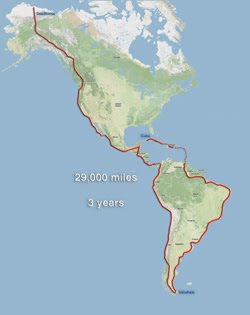
Adventurise
Adventure racing is fun. Tough, muddy, fun and a guilt-free way of consuming 2000 calories of fried food in a single sitting afterwards. As a way of beginning to raise awareness about my cycling expedition around the americas' I spend odd weekends competing in outdoor events where I can chat to like-minded folk and get some feedback about my plans for 2011. Triathlons, cycling sportives, MTB trails, half-marathons etc. are all enjoyable accomplishments but my favourite is adventure racing. This is fantastic and addictive way of exploring large amounts of beautiful English coastline, deep forest, rocky foreshore, serene lakes and muddy trails. Teams and individuals turn up suitably prepared for 4, 8 or even 24 hours of full-on charging around the designated local environment using various modes of travel including, but not limited to: running, mountain biking, kayaking, climbing, zip wires and anything else a devious course setter can accommodate. About 5 minutes before the staggered starts (to stop people following the guy in front!) competitors receive a map which give them fairly precise locations to dozens of electronic checkpoints with differing points values. The rest is simple. Get through as many checkpoints as possible, using the relevant mode of travel, collect the points and return to the finish before the time limit expires, after which penalty points can be incurred at a rate which can render the whole day's exertions as pointless, literally. Checkpoints are usually reasonably well hidden in beach front caves, undersides of rickety wooden bridges, in the middle of a muddy bog or half-way up a tree. You'll return exhausted, probably muddy, maybe wet and definitely hungry. The most proficient competitors will expertly plan and time their route around the area ensuring they reach the finish line with perhaps a minute remaining. As for myself and my teammate, our timing is sometimes a bit out, and we arrive home with 20 or 30 minutes remaining, not really enough to venture back out and find some more points and usually too knackered anyway. However, this methods ensures we tuck in before the BBQ runs out of cheeseburgers. All the winners get is a medal.
Subscribe to:
Posts (Atom)